
| Home Medical Index | First Posted: Aug 28, 2010 Jan 21, 2020 | |
Tetanus or Lockjaw in Horsesby Debora Johnson Diagnosing and Managing Tetanus and Botulism in Horses
 (An excellent article) (An excellent article)Tetanus is a dreadful disease. All warm blooded mammals are able to get tetanus AKA lockjaw. This malady is found all over the globe. 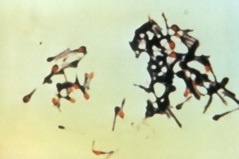  Clostridium tetani with characteristic 'tennis racket' appearance. Clostridium tetani with characteristic 'tennis racket' appearance.Toxin Action
"Tetanospasmin is distributed in the blood and lymphatic system of the host. The toxin acts at several sites within the central nervous system, including peripheral nerve terminals, the spinal cord, and brain, and within the sympathetic nervous system. The toxin is taken up into the nerve axon and transported across synaptic junctions, until it reaches the central nervous system, where it is rapidly fixed to gangliosides at the presynaptic junctions of inhibitory motor nerve endings. The clinical manifestations of tetanus are caused when tetanus toxin blocks inhibitory impulses, by interfering with the release of neurotransmitters, including glycine and gamma-aminobutyric acid. This leads to unopposed muscle contraction and spasm. Characteristic features are risus sardonicus (a rigid smile), trismus (commonly known as 'lock-jaw'), and opisthotonus (rigid, arched back). Seizures may occur, and the autonomic nervous system may also be affected. Tetanospasmin appears to prevent the release of neurotransmitters by selectively cleaving a component of synaptic vesicles called synaptobrevin II." Clostridium tetanian Symptoms in Horses
Prevention of Tetanus in Horses
For More Information: Merck Vet Manual |
