| Home Medical Index | First Posted: Dec 30, 2009 Jan 21, 2020 | |
Leg Problems Most Prevalent in Horses: Bone Spavin, Bog Spavin, Bowed Tendons, Tendon Sheath Effusion, Capped Hocks, Capped Knees, Knee Spavin, Osselets, Shin Splints or Bucked Shins, Speedy Cut (aka brush, cut down, grab a quarter), Sprained Suspensory Ligament, Stocking, Thoroughpin Bursal, Wind Puffs or Wind Galls When does a horse begin to develop osteoarthritis? Typically the onset of osteoarthritis (OA) in adult horses is 4 to 6 years old, but that can vary a great deal due to breed of the horse and its use. Conformation is also a very important consideration leading to OA. A poorly conformed horse is more likely to be predisposed to an arthritic condition that would affect them earlier in life. Predisposing radiographic factors that are present in a young horse can also indicate possible future issues. Age for Onset of Osteoarthritis 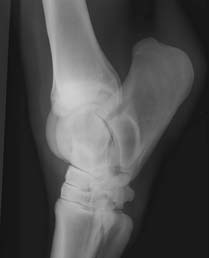 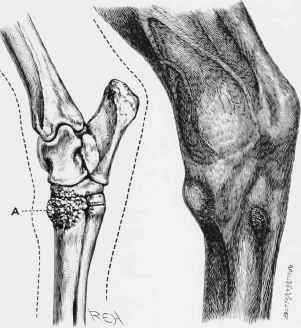

Bowed Tendons - Inflammation and in severe cases even rupture of the sheath encasing the tendon from the knee to the fetlock. One or both the deep flexor tendon and superficial flexor tendons on one and/or both front legs may be affected.  Pool House Veterinary Group and Equine Clinic
Causes:
Tendon Sheath Effusion - What is tendon sheath effusion? 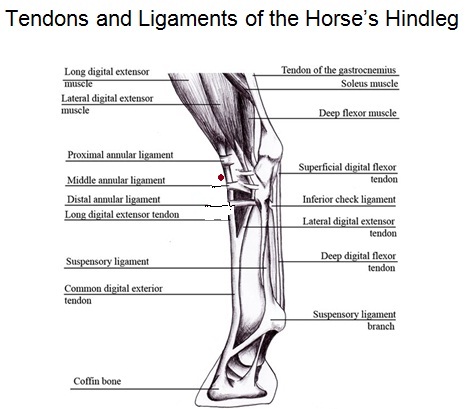 Tendons attach muscles and bone, and are classified as flexors (flex a joint) or extensors (extend a joint). However, some tendons will flex multiple joints and extend another (the flexor tendons of the hind limb, for example, will flex the fetlock, pastern, and coffin joint, but extend the hock joint). In this case, they are classified according to whether they flex or extend the joints of the digit. The following tendons are the main tendons found in the lower leg. When they pass over a joint, they are protected in a tendon sheath, which contains synovial fluid as a lubricant:
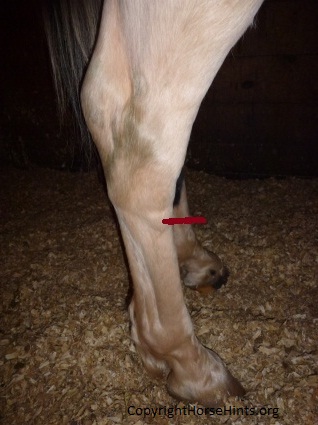
Capped Hocks (Bursal Enlargement) - up to the size of a tennis ball on the point of the hock. Horses may suffer from "capped hock," which is caused by the creation of a false bursa, a synovial sac beneath the skin. Capped hock is usually caused by trauma such as kicking or slipping when attempting to stand. In the absence of a wound, it does not require immediate veterinary attention and is usually only of cosmetic significance. On the other hand, a wound into the calcanean bursa is a serious problem. A capped hock is extremely unlikely to be a cause of lameness, even if severe. 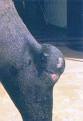
Capped Knees - An acute inflammation (bursal enlargement) or bruise of knee joint (carpitis) and/or the tendon that runs over the front of the knee. Causes:
Joint Capsule Damage: This actually happened to one of our horses. He fell on the ice and exposed the joint. We called the vet immediately and it turned out that the synovial fluid was leaking out into the surrounding tissues. The vet saved the day! Curbs - A "curb" is a swelling at the back of the hock, traditionally considered to be due to a strain of the (long) plantar ligament (PL). The plantar ligament is a tough band of tissue that runs down behind the hock and helps maintain its stability. Inflammation on the upper rear of the cannon area just below the point of the hock may be seen. 
Knee Spavin - A weakening inflammation or growth on either the back or inside edge of a horse's hock. Bony growth at back of knee on inner side. Not very common. Carpal Spavin Surgery, Fine-Tuned Causes:
Osselets - A bony growth on the fetlock joint (the ankle of a horse; the joint located between the cannon bone and pastern bone) which causes inflammation of the surrounding tissues and membranes. There are other related terms such as arthritis, fetlock joint (the ankle of a horse; the joint located between the cannon bone and pastern bone), greenobsoletet (arthritis in the fetlock joint of young horses), osteoarthritis (a severe permanent form of arthritis that grows progressively worse in horses),synoviall fluidcorseletss (the lubricating fluid found in the joints of horses, and chronicobsoletet (the build up of excessive synovial fluid in a damaged joint, usually associated with osteoarthritis). Causes:
Inflammation of the bone above and at the back of the fetlock joint. Any of the ligaments or other anatomical structures of the joint, like theseamedd bones, may be involved. These problems may be particularly difficult to treat. Many horses have been left unsound as a consequence. Causes:
Shin Splints or Bucked Shins - Inflammation of the membrane that covers the Shin bone (cannon bone). A condition in which the splint bones contain excess calcification causing a bump or growth, usually as a result of improper healing of a fracture on the splint bones or due to irritation of the bones. 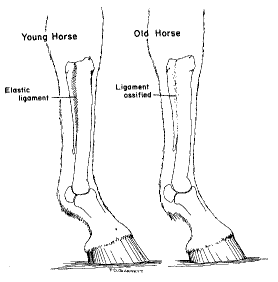 On each side of the cannon bone is a small bone known as the splint bone. The small splint bones are thin and taper to become a small knob about two-thirds of the way down the cannon bone. A ligament, located between the cannon bone and the splint bones, is quite elastic in young horses. As the horse ages, the ligament ossifies; that is, the ligament is replaced by bone and the three bones fuse. During ossification, there may be inflammation and pain. Jumping, running and working a horse during this time produces further irritation. Splints usually occur in horses 2 to 5 years old. Most often it is the forelimbs which are affected. Splints rarely occur in the hind limbs. In older horses, the splint bones are fused solidly to the cannon bone. The majority of splint problems occur on the medial side (inside) of the forelimbs. The medial splint bone usually is the one affected because it has a flat surface next to the knee. The lateral (outer) splint bone has a more slanted surface. When the weight is transmitted to these bones, the medial splint bone probably bears more weight than the lateral splint bone. Therefore, the ligament between the medial splint bone and the cannon bone is subjected to more stress than the outer ligament. Lameness due to splints is most common in 2-year-old horses undergoing training. The lameness is most obvious while the horse is trotting or working or soon thereafter. Lameness may come and go or be present continuously for as long as a year. If you probe up and down along the cannon bone, the horse will flinch when the portion of the ligament undergoing ossification is touched. A large swelling or a number of smaller swellings due to ossification may occur along the length of the splint bones. After the ligament has ossified, the swelling and soreness usually disappears. Causes:
Speedy Cut - An injury to the hock caused by the over reaching gait of a rear leg. Related terms may be brush, cut down, grab a quarter. This is a common occurrence in horse racing. Causes:
Sprained Ankle - Affecting one or more of the ligaments the support the fetlock joint. Causess:
Sprained Suspensory Ligament - The suspensory ligament is attached to the back of the upper cannon and knee (in the front legs) or hock (in the hind legs), runs downwards close to the back of the cannon and divides into two branches each of which attaches to a sesamoid bone, at the back of the fetlock, before ending attached to the upper pastern. The suspensory ligament supports the fetlock and protects it from hyperextension (i.e. dropping too low) at exercise. Causes:
Stocking Up - Fluid retention in the lower limbs. Causes:
Ligaments of the legs include:
Thoroughpin Bursal - "Thoroughpin is a distention of the tarsal sheath of the deep digital flexor tendon just above the hock. It is characterized by plantar fluid-filled swellings visible on both medial and lateral sides proximal to the tibiotarsal joint, which distinguish it from bog spavin ( Serous Tarsitis). It is usually unilateral and varies in size. The lesion is referred to as a tenosynovitis of traumatic origin, but it may not be associated with any detectable inflammation, pain, or lameness. It essentially constitutes a blemish and so is of major clinical importance in show horses. Treatment is by withdrawal of the fluid and injection of hyaluronic acid or a long-acting corticosteroid, which may need to be repeated until the swelling does not recur. Radiation therapy also helps reduce the secretory property of the tendon sheath." Merck Veterinary Manual Causes:
Wind Puffs or Wind Galls Soft - Puffiness in the area of the horse's ankle. The fetlock joint capsule and the flexor tendon sheath may retain fluid: "Spongy" swellings around the back, front and or side of the fetlock joint. The inflamed joint capsule distends with additional synovial fluid in an effort to protect against injury. 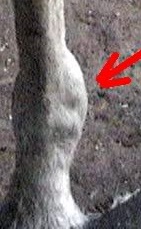
For More Information: Equine LamenessLameness Gaited Horse Carpal Spavin in Horses - Bone Spavin  Horse Bone Spurs Unsoundnesses and Blemishes of Horses: Feet and Legs Horse Tendons and Ligaments Tendon Sheath Effusion, Tenosynovitis The Conservative Approach for Healing Horses |