
| Home Index American Civil War | First Posted Nov 2006 Jan 21, 2020 | |
First Battle of Manassasby Debora Johnson These two cannon pictures were taken by my husband, William Johnson. This is the Battlefield where we ride our two horses, often.
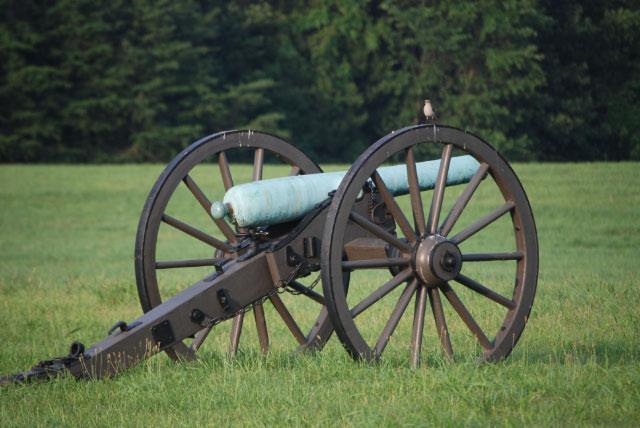 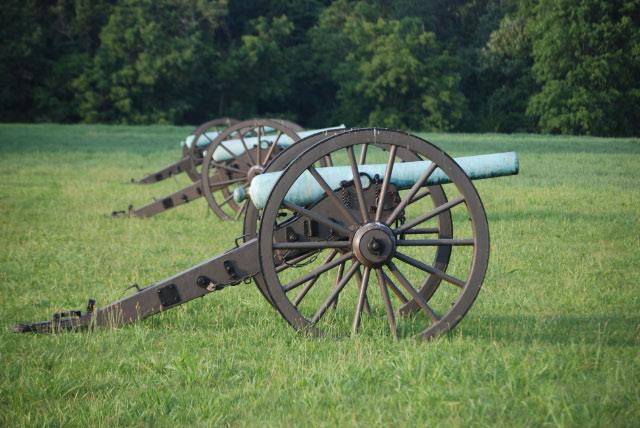 My dear friend, Frank Harrell, has not only taught me to use the computer, but with great patience and perseverance is also teaching me HTML. It is with his permission, that I am using some of his American Civil War "articles and pictures"on my web site. He was the Webmaster for Manassas Battlefield and has written all the Manassas Battle information that appears on this site. Thank you, Frank, for everything, but most of all for you! Hugs, Deb Come ride with my husband, Bill, and myself if you come to Manassas Battlefield in Virginia. We would be happy to show you the trails; there are many. You can do an entire day of riding depending upon how fast you ride. The grounds are beautiful and steeped in our rich history. There are streams, fields, woods, and an abundance of flora and fauna. You can walk, trot, canter, gallop and gait. It is your pleasure. The horse trails are marked and you must stay on them. There is a small fee for the day. There are two trailer parking areas only, at present. Also, remember that walkers are allowed to use the horse trails as well as the hiking trails, so you must be alert. All dogs must be leashed--often the dog walkers think that their dog is exempt. Contact us if you need our help. We always enjoy meeting new horse people.
 Irvin McDowell's Army, 35,000 strong, marched out to begin the long-awaited campaign to capture Richmond and end the war. It was an Army of Green Recruits, few of whom had the faintest idea of the magnitude of the task facing them. But their swaggering gait showed that none doubted the outcome. As excitement spread, many citizens and Congressmen with picnic baskets followed the Army into the field to watch what all expected would be a colorful show. Irvin McDowell's Army, 35,000 strong, marched out to begin the long-awaited campaign to capture Richmond and end the war. It was an Army of Green Recruits, few of whom had the faintest idea of the magnitude of the task facing them. But their swaggering gait showed that none doubted the outcome. As excitement spread, many citizens and Congressmen with picnic baskets followed the Army into the field to watch what all expected would be a colorful show.
Many of these troops were 90-day volunteers summoned by President McDowell's lumbering columns were headed for the vital railroad junction at Manassas. Here the Orange and Alexandria Railroad met the Manassas Gap Railroad, which led west to the Shenandoah Valley. If McDowell could seize this junction, he would stand astride the best overland approach to the Confederate's capital.
On July 18th McDowell's Army reached Centreville. Five miles ahead a small meandering stream named Bull Run crossed the route of the Union advance, and there guarding the fords from Union Mills to the Stone Bridge waited 22,000 Southern troops under the command of General On the morning of July 21, McDowell sent his attack columns in a long march north toward Sudley Springs Ford. This route took the Federals around the Confederate left. To distract the Southerners, McDowell ordered a diversionary attack where the Warrenton Turnpike crossed Bull Run at the Stone Bridge. At 5:30 AM the deep throated roar of a 30-pounder Parrott rifle shattered the morning calm, and signaled the start of battle. McDowell's new plan depended on speed and surprise, both difficult with inexperienced troops. Valuable time was lost as the men stumbled through the darkness along narrow roads. Confederate Colonel Nathan Evans, commanding at the Stone Bridge, soon realized that the attack on his front was only a diversion. Leaving a small force to hold the bridge, Evans rushed the remainder of his command to Matthews Hill in time to check McDowell's lead unit. But Evan's force was too small to hold back the Federals for long.
Soon brigades under Brigadier General
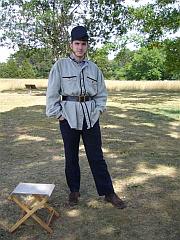
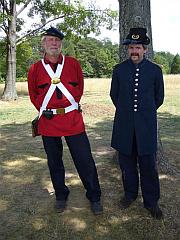
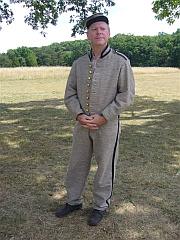
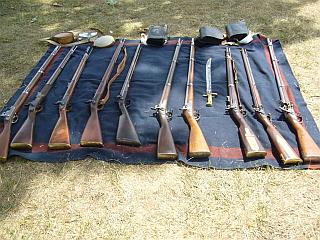
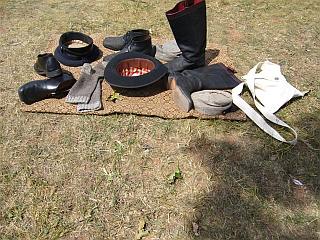
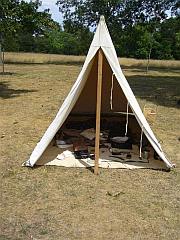
About noon, the Federals stopped their advance to reorganize for a new attack. The lull lasted for about an hour, giving Johnston and Beauregard enough time to stabilize their lines. Attempting to rally his men, Bee pointed to General At first the withdrawal was orderly. Screened by the regulars, the three-month volunteers retired across Bull Run, where they found the road to Washington jammed with the carriages of Congressmen and others who had driven out to Centreville to watch the fight. Panic now seized many of the soldiers and the retreat became a rout. The Confederates, though bolstered by the arrival of President Jefferson Davis on the field just as the battle was ending, were too exhausted and disorganized to pursue the Union army back into Washington. Daybreak on July 22 found the defeated Union Army back behind the bristling defenses of Washington. The Southern Grays describe themselves as a progressive group of living historians who work with various National Park Service, state, and local historical sites to provide interpretive programs for the public. They portray Confederate military throughout all periods of the war, militia, civilians, and occasionally Federal soldiers. Their range of impressions starts with 1860 and 1861 Virginia militia and a documented first Manassas uniform of the 10th Virginia. Their impressions continue with early, mid and late war Confederate infantry and artillery. The Southern Grays emphasize public education demonstrations, memorial events and preservation activities. They occasionally participate in quality re-enactments and video productions such as the 2001 Manassas National Park Service visitor center film. Many of their members live in the northern Shenandoah valley and Northern Virginia. Their active membership also includes men from locations ranging from North Carolina to West Virginia. Because many National Park Service sites have entrusted this organization to support their interpretive programs, The Southern Grays get to experience situations not available to most people. They have slept next to the Dunker Church at Sharpsburg, have been under arms in Devil's Den, have fired muskets from the trenches at Petersburg and original Napoleon cannons from Confederate Avenue in Gettysburg. My husband and I attended the 146th Celebration of the Battle of Manassas at the Manassas Battlefield. The Southern Grays were participating in this celebration. They were dressed in historic costume and were displaying rifles, tents, gear, and other items of the time. Wonderful lectures were given by Henry Elliot, a Ranger at the Manassas Battlefield. We rode our horses that week end at the Battlefield and experienced the historical excitement from horseback.
        |
 On a warm July day in 1861, two great armies of a divided nation clashed for the first time on the fields overlooking Bull Run. Their ranks were filled with enthusiastic young volunteers in colorful new uniforms, gathered together from every part of the country. Confident that their foes would run at the first shot, the raw recruits were thankful that they would not miss the only battle of what would surely be a short war. But any thought of colorful pageantry was suddenly lost in the smoke, din, dirt, and death of the battle. Soldiers on both sides were stunned by the violence and destruction they encountered. At day's end nearly 900 young men lay lifeless on the fields of Matthews Hill, Henry Hill, and Chinn Ridge. Ten hours of heavy fighting swept away any notion the war's outcome would be decided quickly.
 Abraham Lincoln after the startling news of Fort Sumter burst over the Nation in April 1861. Called from shops and farms, the recruits had little knowledge of what war would mean. The first day's march covered only eight kilometers (5 miles) as many stayed back to pick blackberries or fill canteens.
 Pierre G.T. Beauregard. McDowell initially probed the Confederate center, but his troops were checked at Blackburn's Ford. He then spent the next two days scouting the Southern left flank. In the meantime, Beauregard asked the Confederate Government at Richmond for help. General
  Joseph E. Johnston, stationed in the Shenandoah Valley with 10,000 Confederate troops, was ordered to support Beauregard. Johnston gave an opposing Union force the slip, and, employing the Manassas Gap Railroad, started his army toward Manassas Junction. Most of Johnston's troops arrived at the junction on July 20 and 21, some marching from the trains directly into battle.
 Barnard Bee and Colonel Francis Bartow
 marched to Evans' assistance. But even with these reinforcements, the thin gray line collapsed and Southerners fled in disorder toward Henry Hill.
 Thomas Jackson, and shouted the now famous words, "There stands Jackson
 like a stone wall!" The battle raged until just after 4:00 PM, with each side trying to force the other off Henry Hill. Then fresh Southern units crashed into the Union's right flank on Chinn Ridge, forcing McDowell's tired and discouraged soldiers to withdraw.